
Railway alternatives in 2026: apps, databases and AI sandboxes


The best Railway alternative depends on what you need to move. Lizard's app and database resource rates are 10% below Railway's published rates for the same billable usage; the monthly plan minimum still matters. Render is a good fit for an app with Postgres and background workers. Fly.io gives you more control over VMs and regions. Coolify lets you run the stack on your own servers. For coding agents, compare Lizard, Northflank, E2B and Daytona against Railway Sandboxes.
Start with the workload: a production service, a database, or a temporary machine that runs an agent. Each has different costs and storage needs. A provider that works well for your API may still leave you choosing a separate sandbox service.
We build Lizard, one of the options below. Prices checked on October 22, 2026. The cost examples are calculations from published rates; they assume the stated usage and runtime.
Railway alternatives at a glance
| Platform | A good fit for | Pricing to check | Main trade-off |
|---|---|---|---|
| Lizard | Lower app and database resource costs, plus coding-agent tasks | App/DB resource rates 10% below Railway; Pro: $19/month including $19 of usage; Small Sandboxes: $0.0162/hour | The monthly minimum matters for light use; check template and region availability |
| Render | Web apps, Postgres, workers and cron jobs | Hobby workspace: $0; Pro workspace: $25/month, with compute charged separately | Include the workspace, each service and bandwidth in your estimate |
| Fly.io | Apps needing VM control or region placement | Resource billing with no monthly platform fee | You make more decisions about VM size, storage and deployment layout |
| Northflank | Apps, jobs and databases with a path to your own cloud | Resource pricing; BYOC has its own costs | More infrastructure options also mean more configuration to understand |
| Coolify | Teams that want to host apps and databases on their own servers | Self-hosted software is free; servers cost extra | You operate the servers and own recovery of application data |
| E2B | Code execution inside an AI product | Hobby has no plan fee plus usage; Pro is $150/month plus usage | Session limits and concurrency determine which plan you need |
| Daytona | Agent workspaces with SDK control and reusable setups | CPU: $0.0504/vCPU-hour; memory: $0.0162/GiB-hour | Include storage and choose what happens when a workspace stops |
For a small personal project, keeping Railway is also worth considering. Its Hobby plan costs $5/month and includes $5 of usage. Pro costs $20/month and includes $20. Those amounts count toward the bill; adding them to all usage a second time overstates the price. Railway plans
Railway vs Lizard: app hosting and database prices
Lizard charges 10% less per unit of CPU, memory, volume storage and outgoing traffic than Railway's published service rates. These Lizard rates cover apps, Managed Postgres and Managed Redis. The comparison below uses service rates; sandbox compute has its own prices later in this guide. Railway pricing, Lizard resource rates
Compare the same amount of usage
For a common monthly basis, multiply both providers' per-second rates by 730 hours, or 2,628,000 seconds. The amounts below use the same billed units and round only the final cost. They describe usage, not a reserved server size.
| Resource usage | Railway | Lizard | Lizard rate saving |
|---|---|---|---|
| 1 vCPU used continuously for 730 hours | $20.29 | $18.26 | 10% |
| 1 GB of billed memory for 730 hours | $10.14 | $9.13 | 10% |
| 10 GB of billed volume storage for 730 hours | $1.58 | $1.42 | 10% |
| 100 GB of billable outgoing traffic | $5.00 | $4.50 | 10% |
The 10% difference comes from the unrounded per-second and per-GB rates. Railway's docs also show monthly estimates; using both providers' per-second prices avoids mixing different month lengths and rounding.
Example: one app, Postgres and Redis
Assume one instance of each service runs for 730 hours, with these average billed resources:
- App: 0.5 vCPU, 1 GB of memory, no Persistent Volume and 100 GB of billable outgoing traffic.
- Postgres: 0.5 vCPU, 2 GB of memory and 20 GB of billed volume storage.
- Redis: 0.1 vCPU, 1 GB of memory and 5 GB of billed volume storage, including persistence files.
Assume the databases have no billable external traffic. On Railway, use private networking for app-to-database connections to avoid public egress charges. Railway network cost controls
| Service | Railway resource cost | Lizard resource cost |
|---|---|---|
| App | $25.29 | $22.76 |
| Postgres / Managed Postgres | $33.59 | $30.23 |
| Redis / Managed Redis | $12.96 | $11.67 |
| Combined monthly usage | $71.84 | $64.65 |
For example, Railway's app subtotal is 2,628,000 × (0.5 × $0.00000772 + 1 × $0.00000386) + 100 × $0.05 = $25.28816. Lizard's corresponding rates give $22.759344. Totals use unrounded subtotals.
That is 10% less, or about $7.18 a month, for the listed resources. Apply the plan minimum once to the combined account usage: Railway Pro includes $20 and Lizard Pro includes $19. Both totals exceed those minimums, so neither plan adds another subscription charge on top. Railway Pro also accommodates the example's 20 GB database volume; Hobby's listed volume limit is 5 GB.
This estimate excludes builds, backups, extra replicas, object storage, model tokens and tax differences. Railway service builds are free; Lizard build compute can add usage. Different CPU performance, memory accounting or database settings can change measured consumption. Use your own usage history to price a migration; this example is a rate calculation, not a performance benchmark.
When the monthly minimum changes the result
The Redis row is a resource subtotal within this project. If it were the only service in a new account, the listed usage would produce a $20 Railway Pro bill or a $19 Lizard Pro bill. An eligible Railway Hobby user would pay about $12.96, below Lizard's $19 minimum. For a very small account, Railway Hobby can therefore cost less even though Lizard's resource rates are lower. Railway plan terms, Lizard plan terms
Railway's October 2026 security incident and recent outages
Reliability and secret handling may be your main reasons to look for a Railway alternative. Here is what Railway has reported, with the affected systems and limits of the available evidence.
October 21: possible exposure of customer secrets
On October 21, Railway disclosed suspicious activity in systems that store customer environment variables. Its initial investigation indicated that an unauthorized third party may have accessed encrypted variables and obtained the decrypted contents of some of them. Those variables can contain API keys, database passwords and private registry credentials.
Railway said the affected group might be limited to some users, but urged all users to rotate stored secrets and registry credentials and review service logs. It also contacted upstream AI providers to revoke keys. At the time of this review, the disclosure did not establish the final number of affected accounts or explain the entry point. Railway's security disclosure
The response also disrupted operations. Railway paused builds and deployments, so customers could not immediately redeploy applications with replacement credentials. It rotated bucket credentials and invalidated all Railway API tokens. The incident also affected the dashboard, API, CLI and support site.
In its October 22, 08:44 UTC update, Railway said builds had resumed for Pro and Enterprise, with many deployments still queued and wait times growing. Hobby, Free and Trial builds were still awaiting restoration. This is a dated account of an ongoing incident; check the incident timeline for later updates.
If you migrate after this incident, issue fresh credentials at the destination. Moving the same API keys or database passwords does not revoke copies someone may already hold.
Recent service and deployment incidents
Railway's reports document several other disruptions in the weeks before the security disclosure. The table separates failures that blocked access to running services from problems with builds, storage or the dashboard.
| Date in 2026 | What happened | Customer impact and recovery |
|---|---|---|
| September 30 | A new routing service deployed before its required database schema update. Failed route lookups produced 404 responses. | New connections to hosted domains failed across all regions for about five minutes, roughly 07:35 to 07:40 UTC. Existing connections continued; Railway reported no data loss. Routing recovered when the migration finished. Postmortem |
| October 3 | Some US West hosts stopped responding. Railway restarted them; the report does not give a deeper root cause. | Apps and databases on those hosts became unreachable, and redeploys could stall. The first published update was at 11:43 UTC; Railway marked the incident resolved at 19:33 UTC. Incident |
| October 4 | Attached storage slowed for some US West users. Railway said it identified the cause without publishing its details. | Slow queries, delayed service starts and intermittent crash loops. The record runs from 00:34 to 06:23 UTC, with storage performance returning to normal. Incident |
| October 5 | API pods developed long event-loop delays and failed liveness checks. | The dashboard loaded slowly or became hard to access. Railway added capacity and closed the incident at 16:12 UTC after its 15:37 UTC notice. Incident |
| October 9 | An upstream Docker Hub incident caused image pulls to fail, including with HTTP 429 errors. | Builds and deploys using Docker Hub images failed; other registries were unaffected. Railway's incident record runs from 21:29 to 22:07 UTC. Failed deploys needed a retry. Incident |
| October 13 | US West build infrastructure slowed. Railway added capacity and rolled out a fix without publishing the root-cause details. | Builds took longer in that region. Other regions were unaffected. The incident ran from its 16:12 UTC notice to resolution at 17:00 UTC. Incident |
| October 20 | Railway paused new builds across all plans while fixing an issue. Its public record does not explain the root cause. | Existing running services stayed up. Deploy triggers during the pause were not queued, and scheduled cron runs were missed. The notice appeared at 17:03 UTC; all builds resumed by 20:56 UTC. Incident |
These timestamps describe Railway's public incident records. Individual services may have recovered sooner, and the first notice may follow the start of a problem. The October 9 failure originated at Docker Hub; several other incidents affected only a region or a control interface.
Use this history when you assess the cost of interrupted deployments, missed jobs and credential rotation. For every provider on your shortlist, check its incident reports, backup recovery and secret controls. Firecracker isolation addresses the boundary around a workload; it does not by itself establish how a provider protects secrets in its management systems.
Railway app alternatives: hosting and databases
If you want to move a web application, compare the whole project. Write down the web service, workers, scheduled jobs, database, Redis queues, uploaded files and domains. A cheap web instance covers only part of that list.
Lizard: apps, databases and agent compute in one account
Lizard combines app deployment with Managed Postgres, Managed Redis and Managed Object Storage. Lizard Sandboxes give agents a separate machine to change code, run tests and preview an app before you deploy it.
For an app with a database, the price comparison above shows how Lizard's lower resource rates affect the project total. For a product that creates software for users, the agent also needs a disposable workspace while the resulting application needs a deployed service and durable data. You can use Lizard CLI for both parts of that workflow. Lizard documentation
Pro costs $19 a month and includes $19 of usage across the products. Extra usage is pay as you go. New accounts get a seven-day trial with $5 of usage and a card requirement. For a project that would stay below Railway Hobby's $5 minimum, Lizard's lower sandbox rate alone does not justify switching. Lizard pricing
Check the current sandbox limits before moving an agent workflow. For example, Lizard's interactive shell command does not provide SSH protocol access for scp or port forwarding. A workflow that depends on those tools needs changes.
Render: a close match for a web app and its workers
Render has explicit service types for web apps, private services, background workers and cron jobs, plus Postgres and Redis-compatible Key Value. Its Railway migration guide maps these resources and explains how to replace Railway reference variables with the new datastore URLs.
Consider it when you want to keep the familiar pattern of connecting a repository, setting build and start commands, and adding a database. Check the selected instance size for every service, including workers that receive no HTTP traffic.
Render's Pro workspace costs $25/month with unlimited team members. Compute and metered features cost extra. That is a different calculation from a subscription that includes an equal amount of resource usage. Render's workspace pricing update
Render also lists Sandboxes as early access. Check access and limits before making them a requirement for a migration. Render Sandboxes
Fly.io: control over Machines and placement
Fly Machines are VMs you can manage through an API. Fly Launch handles common app deployments, while direct Machine control lets you choose resources, regions and lifecycle behavior. This is useful when region placement or a custom VM workflow drives the move. Fly Machines
Fly.io has no monthly platform fee. Its published examples include a shared-CPU Machine with 256 MB of RAM at $2.19 per 30 days in its lowest-priced regions. That is an entry-size example, not a quote for a complete application. Database, volume, network and other charges depend on the resources you add. Fly.io resource pricing
Compare shared and performance CPU options separately. Matching the vCPU count does not establish equal performance.
Northflank: more control over where the stack runs
Northflank is worth considering when your requirements include services, scheduled jobs, databases or GPU workloads. Its published compute rates are $0.01667 per vCPU-hour and $0.00833 per GB-hour, with disk and egress billed separately. Northflank pricing
It also supports sandboxes in your own cloud. That gives teams a path to control infrastructure placement while keeping Northflank's deployment tools. Check the chosen runtime: its BYOC documentation distinguishes microVM isolation through Kata Containers from gVisor and ordinary containers. Installing sandbox runtimes alone does not select one for a workload. Northflank BYOC sandbox documentation
This option makes most sense when your team has a concrete need for that control and can maintain the configuration.
Coolify: deploy to servers you own
Coolify's self-hosted edition is free software. Coolify Cloud starts at $5/month for connecting two servers, but you still supply and pay for the servers that run your apps. Coolify pricing
That can work well if you already operate a VPS and want a deployment interface for apps and databases. You also take responsibility for server updates, capacity and recovery. Coolify supports database backups, but support varies by engine: PostgreSQL has a scheduled backup and restore workflow, while Redis needs its own persistence and backup approach. Coolify database options
Treat a server that runs customer-supplied code as a separate design problem. Keep it apart from production database credentials and decide how each execution is isolated before you accept untrusted workloads.
Choosing a Railway sandbox alternative
Railway Sandboxes are full Linux VMs with command execution, files, templates, checkpoints and forks. They can join a project's private network, and their base image includes coding agents such as Claude Code and Codex. A replacement needs to cover the parts your application actually uses. Railway Sandboxes
For example, a code-review agent may need a repository checkout and a test runner. A browser agent also needs a working browser. An agent that runs several experiments from the same state needs to know whether a fork includes memory and running processes or just files.
Lizard Sandboxes: low compute rates for repeated agent work
Lizard Sandboxes run in Firecracker microVMs with a separate guest kernel. Lizard SDK supports TypeScript and Python; Lizard CLI can create a sandbox, execute commands and exchange files. Templates include coding-agent setups and a desktop. Sandbox documentation
The Small size provides 2 vCPU, 4 GB of RAM and 5 GB of local disk for $0.0162/hour. Lizard bills running time by the second, including time spent idle. A successful pause stops compute charges; Persistent Volumes continue to incur storage charges. Sandbox egress includes 2 TB per account over a rolling 30 days. Billing and usage rates
We tested a Claude Code workflow on October 18: upload a Git bundle, clone it in a Firecracker sandbox, have Claude fix a failing Python test, rerun the test independently, download the change and pause the sandbox. The test passed. The Claude Code sandbox guide contains the commands and tested versions.
For your own trial, use a failing test from your repository and compare the returned diff, test result and total billed runtime. Include setup and dependency installation in that runtime.
E2B: a focused API for code execution
E2B fits products that give an agent a Linux VM to run code. Its lifecycle API supports connecting, pausing, resuming and ending a sandbox. A continuous session can run for up to one hour on Hobby or 24 hours on Pro; pause and resume preserves state and resets that runtime window. E2B lifecycle documentation
At the listed rates, 2 vCPU and 4 GiB of RAM cost $0.1656 per running hour before plan fees. Pro costs $150/month plus usage. Check session length and concurrent sandbox requirements before comparing a monthly total. E2B pricing
Daytona: workspaces with files, Git and process tools
Daytona has SDKs and tools for working with files, Git, processes, terminals and previews. It also documents snapshots and storage options for reusable workspaces. These features suit agents that need more than a single code execution. Daytona documentation
Its Linux CPU and memory rates also total $0.1656/hour for 2 vCPU and 4 GiB of RAM. Storage above the first 5 GiB costs extra at the published rate. Check the persistence settings for files you need between tasks and the lifecycle rules that stop compute charges. Daytona pricing
Fly Machines and Northflank can also support agent workloads. Choose between them based on the infrastructure controls you need and the amount of lifecycle code you want to maintain.
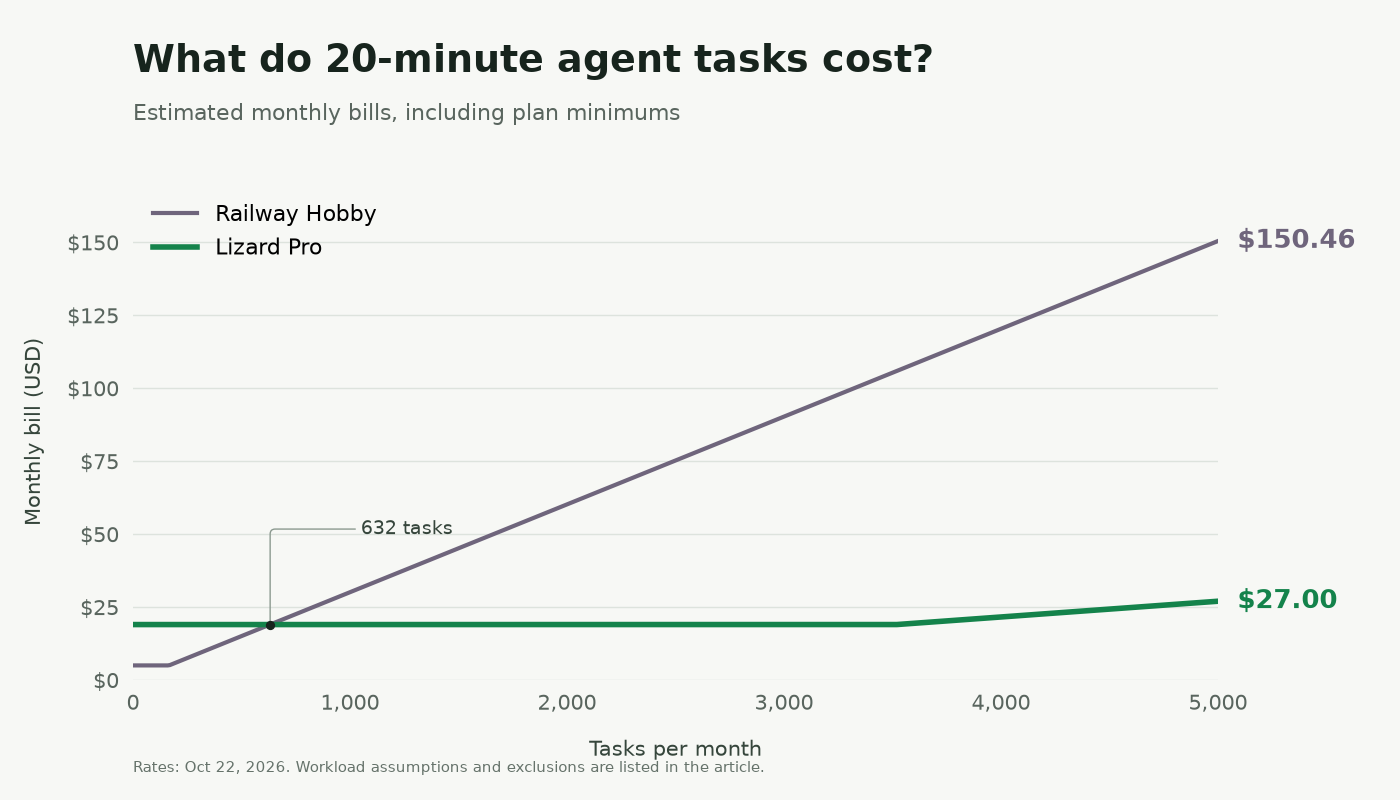
Railway vs Lizard: what do 20-minute agent tasks cost?
Railway bills sandbox usage from measured CPU use and memory in use. Its documentation says memory includes the operating system and filesystem cache. Configuring a 4 GB VM does not mean Railway bills 4 GB continuously. Railway sandbox billing
Use Railway's own example workload: a task runs for 20 minutes, averaging 1 GB of memory in use and 0.3 of one vCPU. Assume it also finishes in 20 minutes on a Lizard Small sandbox. That equal-runtime assumption needs a test with your code; these figures compare rates, not execution speed.
Using the published per-second rates:
- Railway compute:
1,200 × (1 + 0.3) × $0.00001929 = $0.0300924per task. - Lizard Small compute:
20 / 60 × $0.0162 = $0.0054per task.
For the monthly estimate, use Railway Hobby and Lizard Pro. Assume the account runs only these tasks, has no promotional credits, and qualifies for the selected plan. Include all setup and cleanup in the 20 minutes. Exclude model tokens, egress, persistent storage and tax differences.
| Tasks per month | Total running hours | Railway compute | Lizard compute | Railway Hobby bill | Lizard Pro bill |
|---|---|---|---|---|---|
| 100 | 33.33 | $3.01 | $0.54 | $5.00 | $19.00 |
| 500 | 166.67 | $15.05 | $2.70 | $15.05 | $19.00 |
| 1,000 | 333.33 | $30.09 | $5.40 | $30.09 | $19.00 |
| 5,000 | 1,666.67 | $150.46 | $27.00 | $150.46 | $27.00 |
Each plan includes usage equal to its monthly fee, so the simplified bill is max(plan fee, resource usage). A Railway Pro account has a $20 minimum instead of Hobby's $5. Other workloads share the included usage on both providers. Railway plan billing, Lizard plan billing
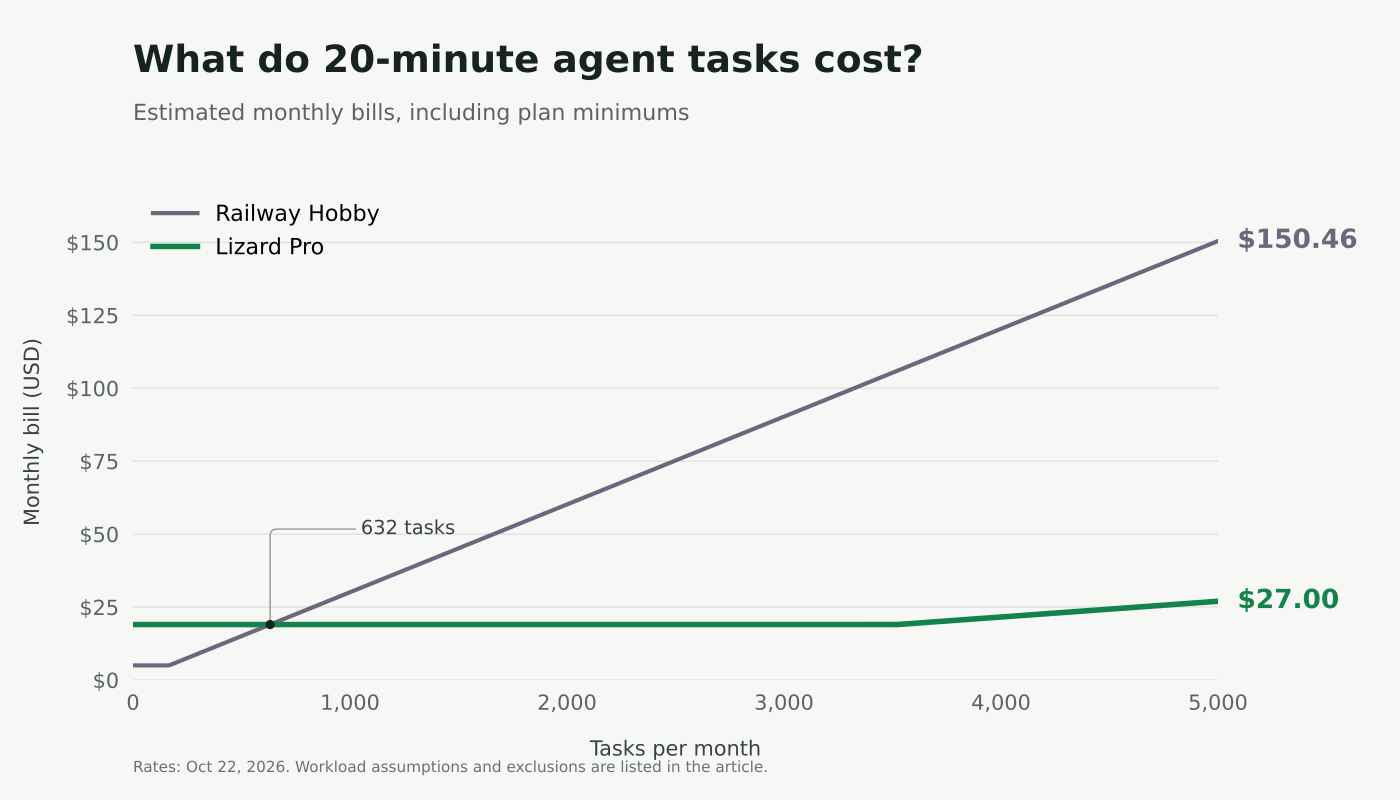
Estimated monthly bills for this workload, including plan minimums. No trial credits or extra resources. Rates checked October 22, 2026.
For a new account doing only this work, Lizard becomes cheaper at about 632 tasks per month. At 5,000 tasks, the estimate is $27 on Lizard versus $150.46 on Railway Hobby. At 100 tasks, Railway's lower minimum wins.
Your result changes with memory use, CPU use, setup time and retries. Keep the same repository, dependencies, model and success criteria when you test. Measure the cost of a completed task, including failed attempts.
Check state and network behavior before switching
The word "fork" does not mean the same thing everywhere. Railway checkpoints and forks copy disk state; the new VM starts without the source's live processes and memory. Its default isolated network allows outbound internet access, while private networking can connect a sandbox to services in the same environment. Railway sandbox behavior
Lizard documents forks that copy memory and processes, with a restriction when a Persistent Volume is attached. For files you need after a sandbox stops, use a Persistent Volume or export the output. A volume is not a backup against node loss. Lizard lifecycle and storage
Before changing SDKs, test these questions with a small fixture:
- Does pause preserve the state your agent needs, and which event ends compute billing?
- What survives a timeout, a stop, a fork and a new sandbox?
- Can the agent reach its test database without receiving production credentials?
- Can you retrieve partial output and retry a failed task without applying the same change twice?
Use limited credentials for each task. VM isolation helps separate execution environments; credentials still determine what the code can access.
Moving a Railway app and database
Start with a staging copy of the project. The destination should pass the application's tests before it receives production traffic.
Record the build and start commands, runtime versions, environment-variable names, volume mount paths and scheduled jobs. Railway reference expressions such as ${{ Postgres.DATABASE_URL }} need the destination's connection settings; copying the expression into another provider will not resolve it there. Render's migration guide shows this mapping in detail.
For Postgres, check the target version, extensions, connection limits and restore permissions. Restore a backup into the test database, then check row counts and application reads and writes. For Redis, identify whether it holds disposable cache data, sessions or jobs that must survive the move. Those uses need different migration plans.
Uploaded files need their own transfer. Check any absolute file paths, public URLs and object-storage credentials. Test the application with a temporary domain, including webhooks and background jobs.
Plan the final data sync around writes: use a maintenance window or a replication method you have rehearsed. Change traffic only after the target is current, and retain a rollback path that accounts for any new writes at the destination.
On Lizard, keep the deployed application and database separate from the sandbox that an agent uses to edit code. The app quickstart and sandbox quickstart cover those two resource types.
Frequently asked questions
What is the best Railway alternative for a web app?
Lizard is worth testing for lower app and database resource rates, with a $19 monthly minimum. Render is a practical option for a web app with Postgres and workers. Fly.io suits teams that want more VM and region control. Coolify suits teams that already operate their own servers.
Are there free Railway app alternatives?
Coolify's self-hosted software is free, but you pay for its server. Northflank lists a free tier with limited services, a database and cron jobs. Check whether the limits cover your full application. Lizard has a seven-day trial followed by a paid Pro plan. Northflank pricing, Coolify pricing, Lizard pricing
What is a good Railway sandbox alternative for AI agents?
Compare Lizard, E2B and Daytona for a managed agent workspace. Add Fly Machines or Northflank if you need more control over infrastructure. Run the same task on your shortlist and check output, state recovery, network access and billed runtime before switching.
Is Lizard cheaper than Railway?
Lizard's listed CPU, memory, volume storage and outgoing traffic rates for apps, Managed Postgres and Managed Redis are 10% below Railway's service rates. The app-and-databases example above costs $64.65 versus $71.84 for the listed monthly usage. In the separate sandbox example, Lizard becomes cheaper for a new paid account at about 632 tasks a month. Railway Hobby's lower monthly minimum can still win for light use.
Do I have to move my application to move its agents?
You can keep the application on Railway and use another provider for agent execution. Connections that currently rely on Railway's private network need a new network path and access controls. Include that work and any transfer charges when you decide whether the savings justify a move.
Try one service or agent task before migrating
For app hosting, deploy a staging copy with Managed Postgres or Managed Redis, replay a representative workload and compare billed usage. For agents, choose a task with a clear pass condition: a test must pass, a preview must load, or an output file must match. Run it in Lizard Sandboxes, record total runtime and check the result. Use the current prices to estimate your monthly bill before moving the rest of the project.
Build with AI. Ship with Lizard.
You don't need a platform team to go live. Your whole cloud, one CLI command away.
- Services
- —
- Add-ons
- —
- Deployments
- —
- Sandbox starts
- —