
Fly.io pricing in 2026: free tier, app costs and alternatives


Fly.io starts at $1.94/month for a shared-CPU Machine with 256 MB RAM in Ashburn, Virginia. A small app with a disk and traffic comes to $9.20 in our example. Add two web instances, a worker and managed PostgreSQL, and the budget reaches $57.39. Fly.io prices.
New accounts get a short free trial: seven days or two total VM hours, whichever comes first. There is no permanent free tier for new signups. Trial terms.
For an always-on app with low average usage, Lizard can cost less. Our worked comparison comes to $4.96 on Lizard versus $7.40 on Fly.io, including storage and traffic. The saving comes from paying for measured CPU and memory use while keeping room for peaks.
We build Lizard. Prices below were checked on September 15, 2026. The budgets use stated workload assumptions; they are estimates, not measured performance results.
What happened to the Fly.io free tier?
Fly.io retired its old plans for new customers on October 7, 2024. Eligible older organizations can still have legacy allowances, which explains why old tutorials and current signup terms disagree. Discontinued plans.
The current trial gives you two total VM hours across all running Machines, with a seven-day deadline. Two Machines running for 30 minutes use one VM hour. Trial Machines also stop automatically after five minutes. Adding a card ends the trial and starts paid usage. Free trial details.
For new paid accounts, Fly.io bills resource usage without a required hosting subscription. The $29 Standard support package is optional. It is not the minimum price to host an app. Billing · Support.
How much does a Fly Machine cost?
The region and memory size both affect the price. These monthly figures cover running compute; storage and traffic cost extra.
| Shared Machine size | Ashburn, US | Amsterdam, EU |
|---|---|---|
| 1 shared vCPU, 256 MB RAM | $1.94 | $2.02 |
| 1 shared vCPU, 512 MB RAM | $3.19 | $3.32 |
| 1 shared vCPU, 1 GB RAM | $5.70 | $5.92 |
| 1 shared vCPU, 2 GB RAM | $10.70 | $11.11 |
Source: Fly.io resource prices.
A shared vCPU has a baseline CPU quota of 6.25%, with extra capacity for bursts. That suits many small APIs; sustained CPU work needs a different budget. These prices do not buy a full core at constant load. CPU quotas.
Memory peaks matter too. An app might use 250 MB most of the day but need 1 GB during startup or a large request. On Fly.io, you pay for the chosen 1 GB Machine whenever it runs. That gap between peak needs and average use is where Lizard's billing can help.
Three Fly.io monthly cost examples
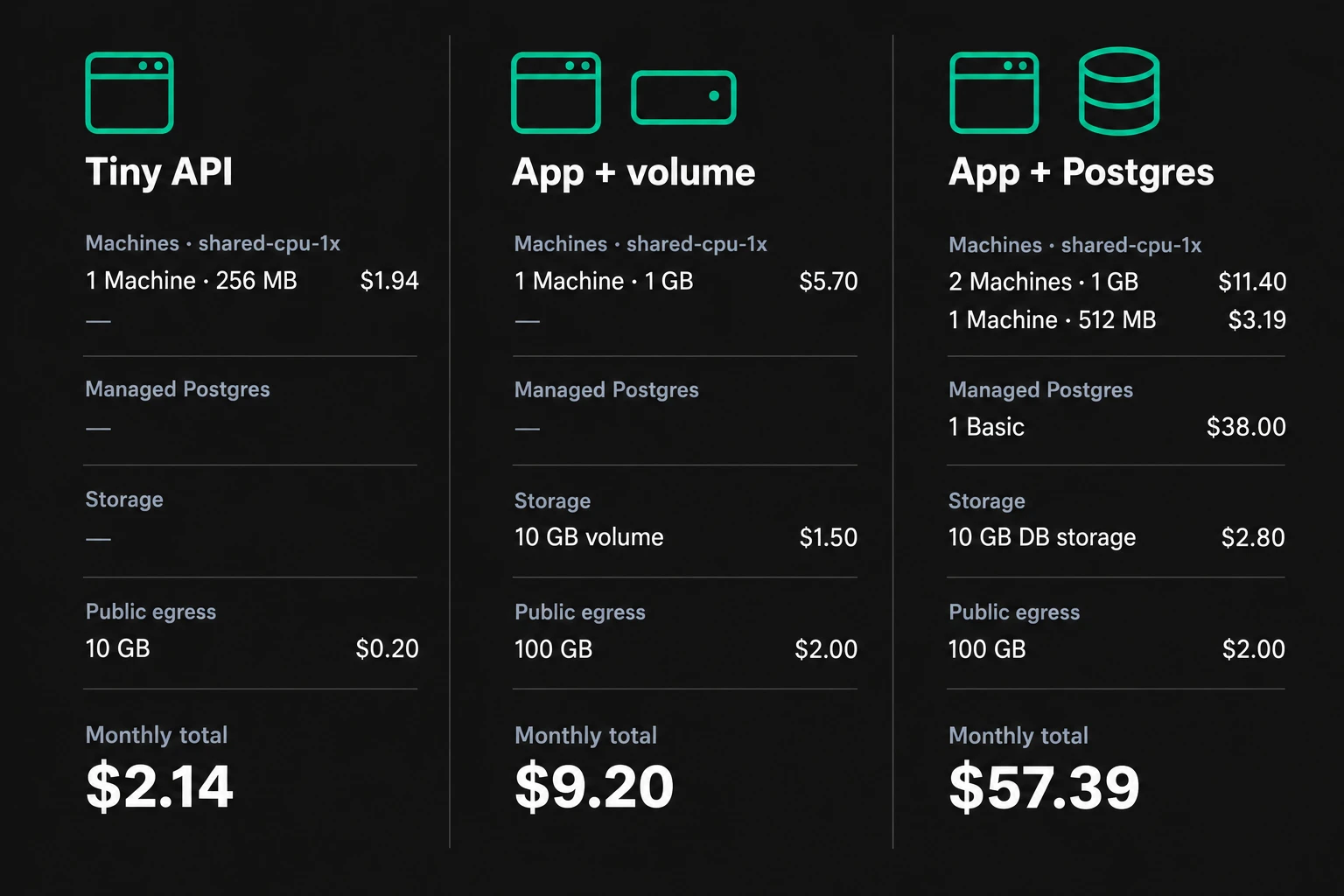
The tiny API uses one 256 MB Machine and 10 GB of outgoing traffic. The app with a volume uses one 1 GB Machine, 10 GB of disk and 100 GB of traffic. The PostgreSQL setup uses two 1 GB web Machines, one 512 MB worker, Basic Managed Postgres, 10 GB of database storage and 100 GB of traffic.
All three run continuously in Ashburn for a 30-day month. Totals cover the listed resources and exclude tax, payment fees, optional extras and reservation discounts. Fly.io's rounded monthly estimates can differ slightly from a metered invoice. Tap the image to enlarge it.
The database drives the third bill: $38 for Basic plus $2.80 for 10 GB of storage. That service includes high availability, backups and connection pooling. A single database instance is a different purchase. Managed Postgres · Rates · Calculator.
Fly.io vs Lizard: what the same app costs
Lizard is a strong choice for small APIs and workers that stay online but spend much of the day waiting for work. You can allow enough memory for a busy moment while paying for what the process actually uses.
Consider an app with a 1 GB memory limit. Over the month, including its peaks, assume it averages 0.25 GB of billed memory and 0.02 vCPU. It runs for all 720 hours, keeps 10 GB of storage and sends 10 GB of public traffic.
| Monthly resource cost | Fly.io, Ashburn | Lizard |
|---|---|---|
| App compute | $5.70 for a 1 GB shared Machine | $2.90 at the assumed usage |
| 10 GB of persistent storage | $1.50 | $1.56 |
| 10 GB of public egress | $0.20 | $0.50 |
| Total | $7.40 | $4.96 |
Lizard costs 33% less in this example. The app stays online on both services. No sleep schedule or annual commitment is needed for that result.
Here is the Lizard compute calculation, using 2,592,000 seconds in 30 days:
CPU:    0.02 vCPU × $0.00000772/s × 2,592,000 = $0.4002
Memory: 0.25 GB   × $0.00000386/s × 2,592,000 = $2.5013
Compute total: $2.90/month
Storage adds $1.5552 and traffic adds $0.50. We round the total at the end. These are resource charges before tax and payment fees. Lizard rates · Fly.io rates.
More room for peaks, a smaller compute bill
The same billing difference helps a queue worker that needs extra memory for short jobs:
| Always-on workload | Fly.io compute | Lizard compute | Modeled saving |
|---|---|---|---|
| API needing a 1 GB limit | $5.70 | $2.90 | 49% |
| Worker needing a 2 GB limit | $10.70 | $2.90 | 73% |
Both rows assume average billed use of 0.25 GB RAM and 0.02 vCPU across the whole month, including busy periods. The worker's 2 GB limit allows brief memory peaks. If those jobs run often enough to raise its average usage, its Lizard bill rises too.
These examples compare billing models, not throughput. Test your workload to check CPU bursts, memory peaks and response times. For a service that reserves more memory than it normally uses, measured billing can leave much less capacity on the bill.
Database cost without a separate subscription
Lizard's Managed Postgres uses the same CPU, memory and storage rates as apps. There is no separate database subscription. For a database averaging 0.05 vCPU and 0.5 GB of billed memory, with 10 GB of billed storage, the 30-day resource estimate is $7.56. Database billing.
Fly.io Basic Managed Postgres with 10 GB of provisioned storage starts at $40.80/month. It includes high availability and backups. The $7.56 Lizard example prices one database instance; it does not price an equivalent HA cluster. For an early app that needs one database, Lizard lets the budget follow that smaller setup. For an HA requirement, compare the full design and recovery guarantees. Fly.io database pricing.
Billing and features that affect the choice
| What matters | Fly.io | Lizard |
|---|---|---|
| Running app billing | Machine size × time running | Actual CPU and memory use |
| New-account trial | 2 total VM hours or 7 days | $10 in credits, valid for 31 days |
| Standard monthly subscription | None required | None required |
| Payment model | Metered usage billing | Prepaid credits; optional auto top-up |
| Database budget | Managed Postgres plan plus storage | Managed Postgres resource use |
| Terminal workflow | flyctl and Machine configuration | Lizard CLI builds, deploys, adds services and shows logs |
| Location choice | Broad regional Machine placement | US and EU regions |
Fly.io billing · Fly.io trial · Lizard pricing · Lizard CLI.
Lizard also keeps apps, Managed Postgres, Managed Redis and Managed Object Storage in one CLI workflow. It detects your stack and builds the app; a Dockerfile is optional. You can deploy and read logs from the same coding agent you use to write the app. That reduces the setup work for a small team. Deployment workflow.
Purchased Lizard credits do not expire. Trial and promo credits can expire, and the top-up screen shows payment fees before purchase. Stored data and an idle process that still holds memory can keep adding to the bill. Billing terms.
When Fly.io can cost less
Fly.io charges $0.02/GB for public egress in North America and Europe; Lizard charges $0.05/GB. In our $4.96 versus $7.40 app example, that difference uses up Lizard's compute saving at roughly 91 GB of monthly egress, if all other assumptions stay the same. At 100 GB, the totals become about $9.46 on Lizard and $9.20 on Fly.io.
Fly.io can also reduce compute costs by stopping Machines between requests. Annual reservations advertise 40% off eligible compute, with upfront blocks and coverage terms. Include those options if your app can sleep or you can commit to a year. Reservations · Autostop.
For a low-traffic API or worker that needs to stay online, start by pricing it on Lizard. For a service sending large amounts of data or needing specific global regions, give Fly.io's network costs and placement more weight.
Try your app on Lizard. Run it through normal traffic and a busy period, then compare the usage bill with your Fly.io Machine sizes. See the Claude Code deployment guide for a walkthrough, or compare other PaaS providers.
Other Fly.io charges to include
| Resource | Published rate |
|---|---|
| Provisioned volumes | $0.15/GB/month |
| Root filesystem while stopped or suspended | $0.15/GB/month, prorated |
| Volume snapshots | $0.08/GB/month; first 10 GB free |
| Public egress: North America and Europe | $0.02/GB |
| Public egress: Asia Pacific, Oceania and South America | $0.04/GB |
| Public egress: Africa and India | $0.12/GB |
| Dedicated inbound IPv4 | $2/month |
Source: Fly.io resource pricing. A shared IPv4 can meet many apps' needs. Static outbound IPs have separate pricing.
At 1,000 GB of outgoing traffic, those regional egress rates mean $20, $40 or $120 before compute. Volumes charge for provisioned capacity; incremental snapshots charge for stored snapshot data. Neither is part of the small Machine headline price. Billing details.
Does stopping a Fly.io app save money?
Yes. Stopped or suspended Machines stop accruing running compute charges, but retained data still costs money.
For example, run a 1 GB Ashburn Machine for 60 hours in a 720-hour month. Keep a 10 GB volume all month, retain a 1 GB root filesystem for the remaining 660 hours, and send 10 GB of traffic. The total is about $2.31: $0.475 compute, $1.50 volume, $0.1375 stopped root storage and $0.20 traffic.
Fly Proxy can start and stop existing Machines as demand changes. A worker needs care: no HTTP requests does not mean the job queue is empty. Check your minimum running count and whether the process can stop safely. Autostop and autostart.
Frequently asked questions
Can I use Fly.io for free forever?
New accounts get a limited trial, not a permanent free tier. Some older organizations retain legacy allowances under their account terms.
Is Fly.io $5 or $29 per month?
Neither is a required monthly hosting price for new accounts. Old tutorials may refer to retired plans. The current $29 Standard support package is optional; hosting resources have their own charges.
Does Fly.io charge when there are no requests?
A running Machine still costs money. Stop or suspend it to stop running compute charges. Retained storage can continue billing.
How much does Fly.io cost with PostgreSQL?
Basic Managed Postgres plus 10 GB of storage costs $40.80/month before app compute. Our example with two web Machines, a worker and 100 GB of traffic totals $57.39.
Is Lizard cheaper than Fly.io?
Lizard can be much cheaper when an app needs room for short peaks but uses far less CPU and memory on average. This can suit APIs waiting for requests, web apps with uneven traffic and workers processing jobs in bursts. Fly.io charges for the chosen Machine size while it runs, including unused capacity. Lizard charges for measured CPU and memory use.
In our worked examples, that means 49% lower compute costs for the API and 73% lower for the worker. The API's total with storage and traffic is $4.96 on Lizard versus $7.40 on Fly.io. These savings come from the stated average usage; an idle process still pays for the memory it holds.
What should I enter in the Fly.io pricing calculator?
Include every web process, worker and replica, with its region, Machine size and running hours. Add the database, disk, traffic and any optional services. Keep the assumptions with the result so you can compare it with the actual bill.
Build with AI. Ship with Lizard.
You don't need a platform team to go live. Your whole cloud, one CLI command away.
- Workspaces
- —
- Services
- —
- Add-ons
- —
- Deployments
- —